What Is a Skill Gap Report? How to Turn Evaluations Into Development Plans
By Career Ladder Builder
The review is done — now what?
Picture a conversation you have probably already had. An employee sits across from you after a performance review, evaluation form freshly scored. They ask the one question every ambitious person asks: "What do I need to do to get to the next level?"
You have scores. You have a few notes. But translating those numbers into a coherent, motivating answer — on the spot, for every person, consistently — is where the best-intentioned evaluation processes quietly fall apart. The scores sit in a spreadsheet. The employee leaves with vague encouragement. Three months later, neither of you can remember what the plan was.
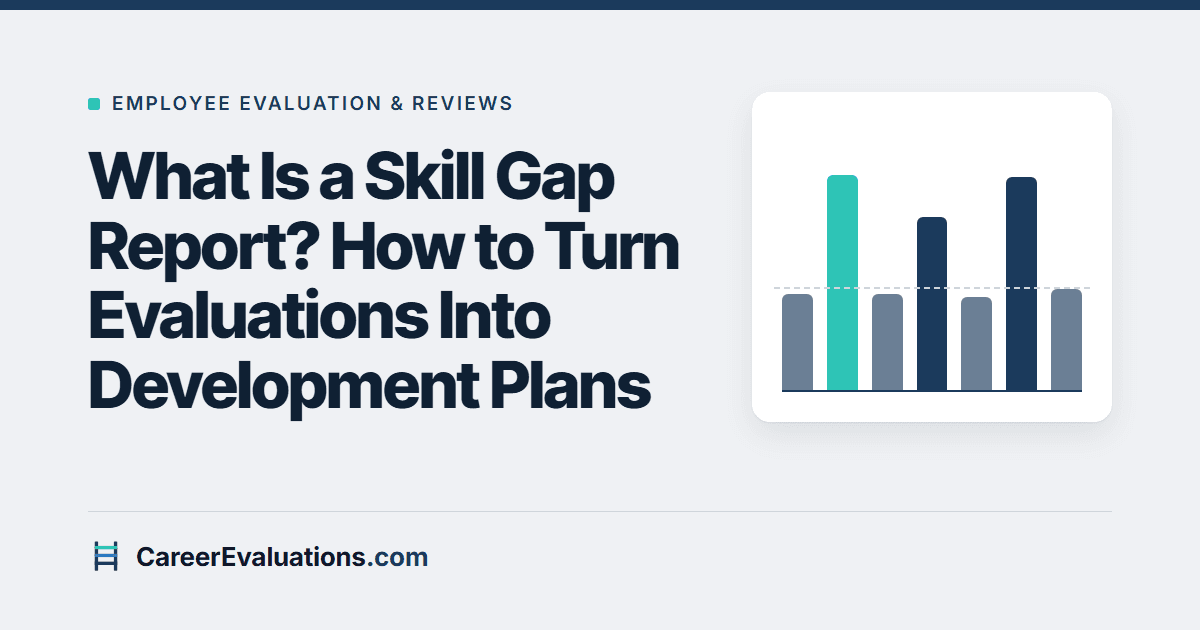
A skill gap report is the bridge between the evaluation you just ran and the development conversation you actually need to have. It takes each competency score, compares it to what the next career level requires, and surfaces exactly where the distance is greatest. Done well, a skill gap report turns a backward-looking assessment into a forward-looking roadmap.
By the end of this article, you will know what a skill gap report contains, how to read one correctly, how to prioritize the gaps that matter most, and how to translate those gaps into a development plan your employee can act on immediately.
What a skill gap report actually contains
A skill gap report is a structured comparison of two things: where an employee scores today against a defined competency framework, and where they need to score to qualify for the next career level on that framework.
To understand the report, it helps to understand the pieces underneath it.
Career level — A named stage on a career ladder (for example: Associate, Mid-Level, Senior, Staff, Principal for an individual contributor track; Team Lead, Manager, Senior Manager for a manager track). Each level has a defined set of competency expectations — the minimum score at which someone is considered performing at that level.
Competency — A specific, observable skill or behavior that the organization has decided to measure. Good competency statements are concrete: "Scopes and delivers projects with minimal oversight" or "Translates business requirements into testable acceptance criteria." Vague competencies ("is a team player") produce scores that are impossible to compare across managers.
Score — A numerical rating, typically on a 1–5 scale, assigned during a formal evaluation, ideally with written evidence notes to anchor the rating.
Gap — The difference between the employee's current score on a competency and the minimum score required by the target level. If the target level requires a 4 on "Cross-functional communication" and the employee scored a 2, the gap is 2. If they scored a 4, the gap is zero — that competency is already met.
The skill gap report aggregates these comparisons across all the competencies in the framework and surfaces them in a single view, typically as a table or visual delta chart. The result is an honest, specific answer to the question your employee just asked.
How to read a skill gap report without misinterpreting it
Raw numbers without context produce bad development conversations. Here are the interpretive rules that keep a skill gap report useful.
Read the gap, not just the score. A score of 2 on a competency sounds alarming in isolation, but if the current level only requires a 2 and the employee is not seeking promotion, there is no gap to act on. Conversely, a score of 3 on a competency that requires a 4 at the next level is the specific, actionable signal worth addressing. Always anchor your reading to the target level, not to an abstract idea of "good."
Distinguish between gap size and gap importance. A gap of 2 on a peripheral competency may matter far less than a gap of 1 on a competency that is gating — meaning the one that most directly determines whether someone is ready to advance. When you look at a full competency set, identify which competencies carry the most weight in the role and prioritize gaps there first.
Treat evidence notes as the real diagnostic. A score tells you how large the gap is. The evidence notes — the specific examples a manager documented to support the rating — tell you why the gap exists and what kind of development will actually close it. A score of 2 on "Stakeholder communication" explained by "struggles to tailor message complexity to a non-technical audience" points toward very different development activity than the same score explained by "rarely initiates communication proactively."
Do not conflate a skill gap report with a performance problem. A skill gap report answers the question "Is this person ready for the next level?" It is not a verdict on whether they are doing their current job adequately. Many strong contributors carry a genuine gap on competencies they have simply not yet had the opportunity to practice. The report surfaces the gap; your job is to figure out whether it reflects lack of opportunity, lack of skill, lack of feedback, or something else.
Prioritizing the gaps that matter most
Most employees will have several gaps across a competency framework. Trying to work on all of them simultaneously is a reliable way to make progress on none of them. A useful development conversation picks two or three gaps and builds real plans around them.
Use this three-step prioritization logic:
Step 1 — Filter for the target level. Exclude competencies already met at the target level. Focus only on the competencies with a positive gap (current score below target score).
Step 2 — Rank by gap size within the role's critical competencies. If your career framework marks certain competencies as foundational to the role — the skills that define the core of the job family — rank gaps on those competencies first, regardless of absolute gap size.
Step 3 — Apply a development feasibility filter. Some large gaps are closeable quickly with a specific assignment or stretch project. Others reflect deeply ingrained behavior patterns or require formal learning that takes months. Factor in what is realistically achievable in the next review cycle. A large gap that is highly coachable in the near term may deserve priority over a smaller gap that requires a structural change in how the employee's role is scoped.
"Employees whose managers hold them accountable for a clear development plan are far more likely to stay — and far more likely to see the plan through. The bottleneck is almost never commitment; it is specificity."
The outcome of this prioritization is a short list: the two or three competency gaps where focused effort in the next three to six months will move the needle most meaningfully. Everything else goes on a watch list for the following cycle.
Turning the skill gap report into a development plan
A development plan is not a list of aspirations. It is a set of specific, time-bound actions tied to named competency gaps, with clear milestones and a defined review date. Here is how to build one from the skill gap report.
Name the competency and the gap explicitly. Start each development objective by writing the competency name, the current score, the target score, and the gap in plain language. "Improve cross-functional communication from a 2 to a 4 (gap of 2)" is a legible starting point. "Get better at communicating" is not.
Identify the development activity type. Not all gaps close the same way. A useful taxonomy borrowed from learning design distinguishes three types of development activity:
- Exposure — learning by observing or studying (reading, shadowing, attending a course, listening to a stakeholder call they would not normally join)
- Experience — learning by doing (a stretch assignment, leading a project, owning a deliverable they have not owned before)
- Feedback — learning through structured reflection (regular 1:1 debrief on a specific behavior, peer review on a deliverable, coached practice in a low-stakes setting)
The most durable development plans combine all three types for each priority gap. Exposure alone rarely changes behavior. Experience without feedback is hit-or-miss. Feedback without experience has nothing to work on.
Set a milestone and a review date. Each development action needs a check-in point before the next formal evaluation. "By the end of Q3, Alex will have led two cross-functional meetings with the Product and Finance teams, with a debrief conversation after each one." That is a milestone. "Alex will work on communication" is not.
Connect the plan to the next evaluation cycle. The employee should be able to look at the development plan and understand exactly what evidence they need to generate before the next evaluation — and the manager should know what to look for. This creates a closed loop: evaluation → skill gap report → development plan → evidence gathering → next evaluation. For a deeper look at how to build this loop intentionally, see our guide on closing the development planning loop.
Document the plan as a shared artifact. Development plans that live only in a manager's memory, a one-off email, or a notes app disappear between cycles. The plan needs to exist somewhere both the employee and the manager can reference, update, and track. When development action items are tracked in the same system as the evaluation scores and the career framework, the loop closes naturally — nothing falls through the cracks at the next cycle. You can read more about structuring those action items effectively in our article on development action items.
A worked example: reading and acting on a skill gap report
Here is a concrete illustration. Suppose you are the HR lead at a 65-person B2B software company. Your career framework for the Software Engineer job family has five competencies for the jump from Mid-Level Engineer (Level 3) to Senior Engineer (Level 4). The minimum score required at Level 4 is a 4 on each competency.
After a completed evaluation cycle, your skill gap report for one engineer — call her Maria — looks like this:
| Competency | Current Score | Target Score (L4) | Gap |
|---|---|---|---|
| Code quality & review | 4 | 4 | 0 |
| Technical design | 2 | 4 | −2 |
| Cross-functional communication | 3 | 4 | −1 |
| Delivery ownership | 3 | 4 | −1 |
| Mentoring & knowledge sharing | 4 | 4 | 0 |
Maria already meets the bar on code quality and mentoring. Three gaps remain. Following the prioritization logic above:
- Technical design (gap of 2) is the largest gap and is foundational to the Senior Engineer role. This is the top priority.
- Delivery ownership (gap of 1) is also critical at the Senior level — a Senior Engineer is expected to drive a project end-to-end without close supervision. This is the second priority.
- Cross-functional communication (gap of 1) matters but is somewhat less gating than delivery ownership for the specific role scope Maria operates in. Watch list for this cycle; revisit if the other two gaps close.
Maria's development plan for the next cycle centers on two things: a stretch assignment in which she leads the technical design for an upcoming mid-complexity feature (experience + feedback), with a weekly debrief with her engineering manager on the design decisions she makes (feedback); and increased ownership of one upcoming project from scoping through delivery (experience), with a retrospective framing specifically around what went well and what she would do differently in project leadership (feedback).
The evidence the next evaluation needs to look for: documented design artifacts Maria authored, a manager assessment of how she led the feature delivery, and evidence notes from the two debrief conversations.
This is what a skill gap report is designed to produce — not a summary of the past, but a precise specification of the next chapter.
The system behind the report
A skill gap report is only as reliable as the framework and the evaluation process underneath it. Three things make the difference between a report that drives real development and one that sits unread:
A defined career framework with level-specific competency scores. If your organization has not yet built a career framework with level-by-level expectations, the skill gap calculation has nothing to compare against. The framework is the prerequisite. See our guide on how to build a career ladder if you are starting from scratch.
A consistent, structured evaluation process. Skill gap reports are only comparable across employees and cycles if the evaluation is run the same way each time — same competencies, same scoring scale, same evidence-note discipline, same review and approval workflow. If one manager scores intuitively and another scores with detailed evidence notes, the gap data is not comparable. Our guide on running your first evaluation cycle in 30 minutes walks through how to set that baseline.
A system that connects evaluation scores to career levels. When evaluations live in email or a disconnected spreadsheet, generating a skill gap report is a manual calculation exercise that most managers skip. When the evaluation tool knows the career framework — the levels, the competencies, the required scores at each level — the skill gap report generates automatically at the close of each cycle, and every employee gets a personalized view of where they stand and what they need to close. You can explore how Career Ladder Builder handles this end-to-end on the features page.
If you are at the stage where you are ready to evaluate employees against a career framework and want to see what an automated skill gap report actually looks like, start a 14-day free trial and run a cycle against a live framework — no credit card required.
The question your employees are already asking
Sixty-three percent of workers who quit in 2021 cited no opportunities for advancement as a top reason — tied with pay (Pew Research Center, 2022). The honest diagnosis behind that number is not usually that advancement did not exist. It is that the path was invisible. Employees could not see what the next level required, could not measure their distance from it, and could not get a straight answer about what would close the gap.
A skill gap report makes the path visible. It converts an evaluation from a judgment into a tool — something the employee and manager can pick up together, point at, and plan from. The conversation changes from "here is how you performed" to "here is exactly what you need to build next, and here is how we will support you in building it."
That is a conversation worth having — and worth documenting. For a closer look at how to assess overall career readiness before promotion, see our guide on how to evaluate employee career readiness.
Enjoying this? Get more HR development guides in your inbox.